

Ecommerce Business Insurance Costs in 2026: What You Need and What It Costs

Insurance is one of the most consistently overlooked costs in ecommerce profit calculations. Most sellers model their margins using product cost, platform fees, shipping, and advertising — and leave insurance entirely out of the equation. This is a mistake that compounds over time. As your business grows, insurance costs grow with it, and failing to account for them from the start means your actual margins are lower than your models suggest.
Beyond the margin impact, insurance is increasingly a business requirement rather than an option. Amazon requires sellers with over $10,000 in monthly sales to carry product liability insurance with Amazon named as an additional insured. Many wholesale buyers and retail partners require proof of insurance before placing orders. And the financial exposure from a single product liability claim, data breach, or inventory loss event can be existential for an uninsured ecommerce business.
Types of Insurance Ecommerce Businesses Need
General liability insurance is the foundation of any ecommerce insurance program. It covers bodily injury and property damage claims arising from your business operations, including claims from customers who are injured by your products. For most ecommerce businesses, a $1 million per occurrence / $2 million aggregate general liability policy is the minimum adequate coverage. Annual premiums for this coverage typically range from $500-1,500 for small businesses with under $500,000 in annual revenue.
Product liability insurance is either included in your general liability policy or purchased as a separate endorsement, depending on your insurer. It specifically covers claims arising from harm caused by products you sell. For sellers of physical products — particularly items that could cause injury if defective (electronics, children's products, food, supplements, sporting equipment) — product liability coverage is non-negotiable. Amazon's requirement for $1 million in product liability coverage for high-volume sellers reflects the platform's own legal exposure, not just seller protection.
Cyber liability insurance covers losses from data breaches, ransomware attacks, and other cyber incidents. For ecommerce businesses that store customer payment information, shipping addresses, and purchase history, a data breach creates both direct costs (breach notification, credit monitoring for affected customers, forensic investigation) and indirect costs (reputational damage, customer churn). Annual premiums for cyber liability coverage range from $800-3,000 for small to medium ecommerce businesses depending on revenue and data handling practices.
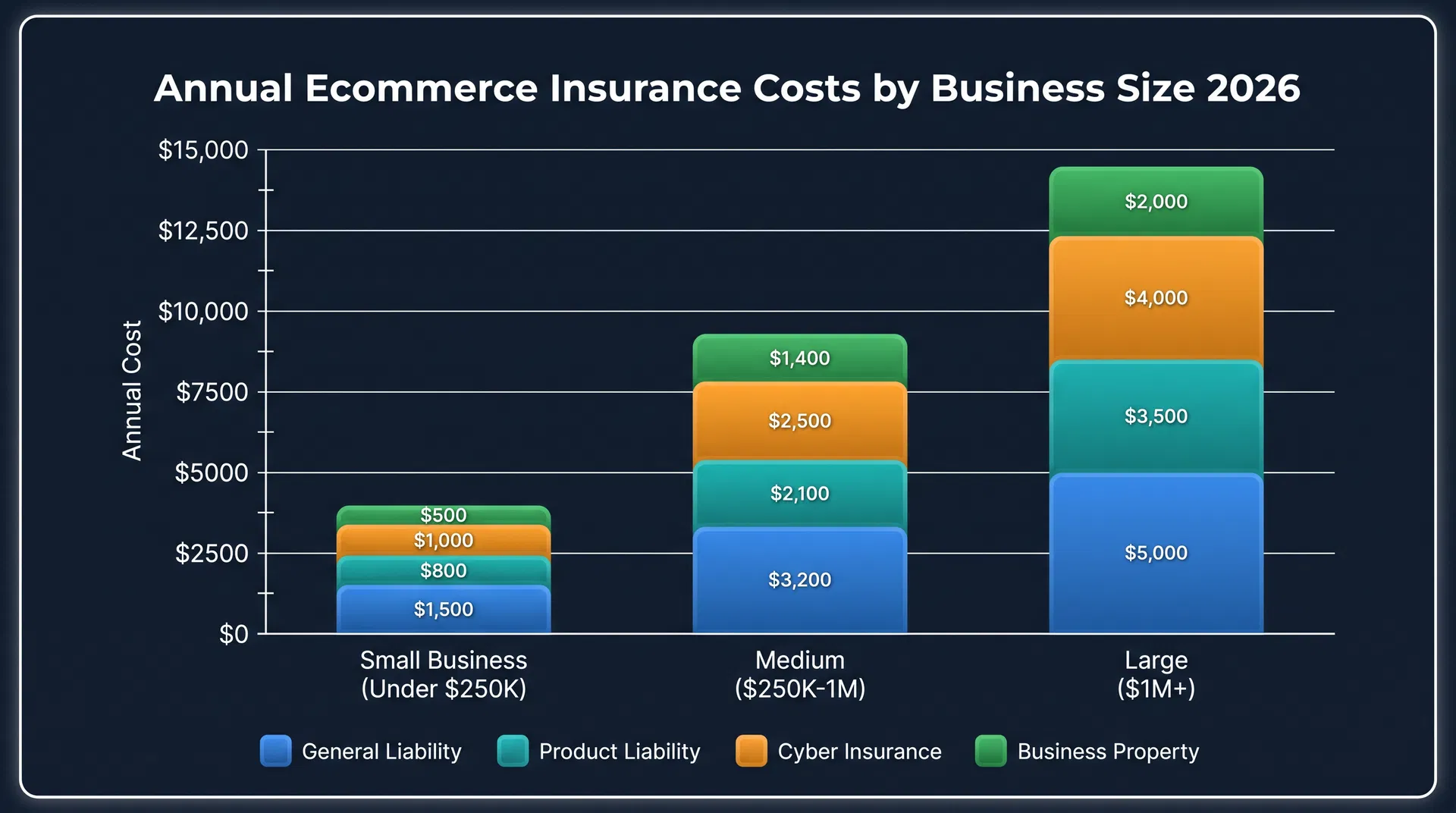
Insurance Cost Benchmarks by Business Size
For small ecommerce businesses with under $250,000 in annual revenue, a comprehensive insurance program including general liability, product liability, and basic cyber coverage typically costs $3,500-5,000 per year. This breaks down to roughly $300-420 per month, or $0.35-0.50 per order at 1,000 monthly orders. At this scale, insurance is a real but manageable cost that should be included in margin calculations.
Medium businesses with $250,000-1,000,000 in annual revenue typically pay $7,000-12,000 per year for comprehensive coverage. At this scale, inventory insurance (covering the value of goods in your warehouse or in transit) becomes important, and the cost of coverage increases proportionally with the value of goods at risk. Inventory insurance typically costs 0.5-1.5% of the insured inventory value annually.
Large ecommerce businesses with over $1 million in annual revenue face insurance costs of $12,000-20,000 or more per year for comprehensive coverage, including directors and officers liability, employment practices liability, and commercial umbrella policies that extend coverage limits above the primary policy limits. At this scale, insurance is typically 0.5-1.5% of annual revenue.
| Coverage Type | Small Biz | Medium Biz | Large Biz |
|---|---|---|---|
| General Liability | $500–1,500 | $1,500–3,000 | $3,000–6,000 |
| Product Liability | $800–1,500 | $1,500–3,500 | $3,500–7,000 |
| Cyber Liability | $800–1,500 | $1,500–3,000 | $3,000–5,000 |
| Business Property/Inventory | $500–1,000 | $1,500–3,000 | $2,000–5,000 |
| Total Annual Estimate | $3,800–5,500 | $7,000–12,000 | $12,000–20,000 |
Amazon's Insurance Requirements
Amazon requires sellers who exceed $10,000 in monthly sales to maintain commercial general liability insurance with a minimum of $1 million per occurrence and $2 million aggregate, with Amazon.com Services LLC named as an additional insured. Sellers must provide proof of insurance within 30 days of receiving the requirement notice. Failure to comply can result in selling privileges being suspended.
Several insurance providers have built Amazon-specific products that meet these requirements and can be purchased quickly online. Providers like Next Insurance, Hiscox, and Thimble offer policies specifically designed for ecommerce sellers that include the Amazon additional insured endorsement. Annual premiums for Amazon-compliant policies typically range from $600-1,500 depending on product categories and revenue levels.
Including Insurance in Your Margin Calculations
The correct way to account for insurance in your product margin model is to calculate your annual insurance cost and divide it by your annual order volume to get a per-order insurance cost. For a business paying $5,000 per year in insurance premiums and processing 2,000 orders annually, the per-order insurance cost is $2.50. This should be included in your cost basis alongside shipping, platform fees, and COGS.
For product-specific liability insurance (relevant for high-risk products like supplements, electronics, or children's items), the cost is often better modeled as a percentage of revenue rather than a flat per-order amount. A product liability premium of $3,000 per year on a product generating $150,000 in annual revenue represents a 2% insurance cost that should be included in the margin model for that specific product.
Put these numbers to work
Run a real product analysis with landed cost, tariffs, and all fees calculated automatically.