

Subscription Box Profit Model: Unit Economics, Margins, and What It Actually Takes to Be Profitable

The subscription box model has an appealing surface-level pitch: predictable recurring revenue, customers who pay before you ship, and the ability to build a brand around curation rather than just product. The reality is more complicated. Subscription boxes have some of the most complex unit economics in ecommerce, with cost structures that are easy to underestimate and churn dynamics that can make a seemingly profitable business unprofitable at scale.
This guide breaks down the complete unit economics of a subscription box business, including every cost category that sits between your subscriber's monthly payment and your actual net profit. If you are evaluating whether to launch a subscription box or trying to understand why your existing box is not as profitable as it should be, this is the analysis you need.
The Core Unit Economics: Where the Revenue Goes
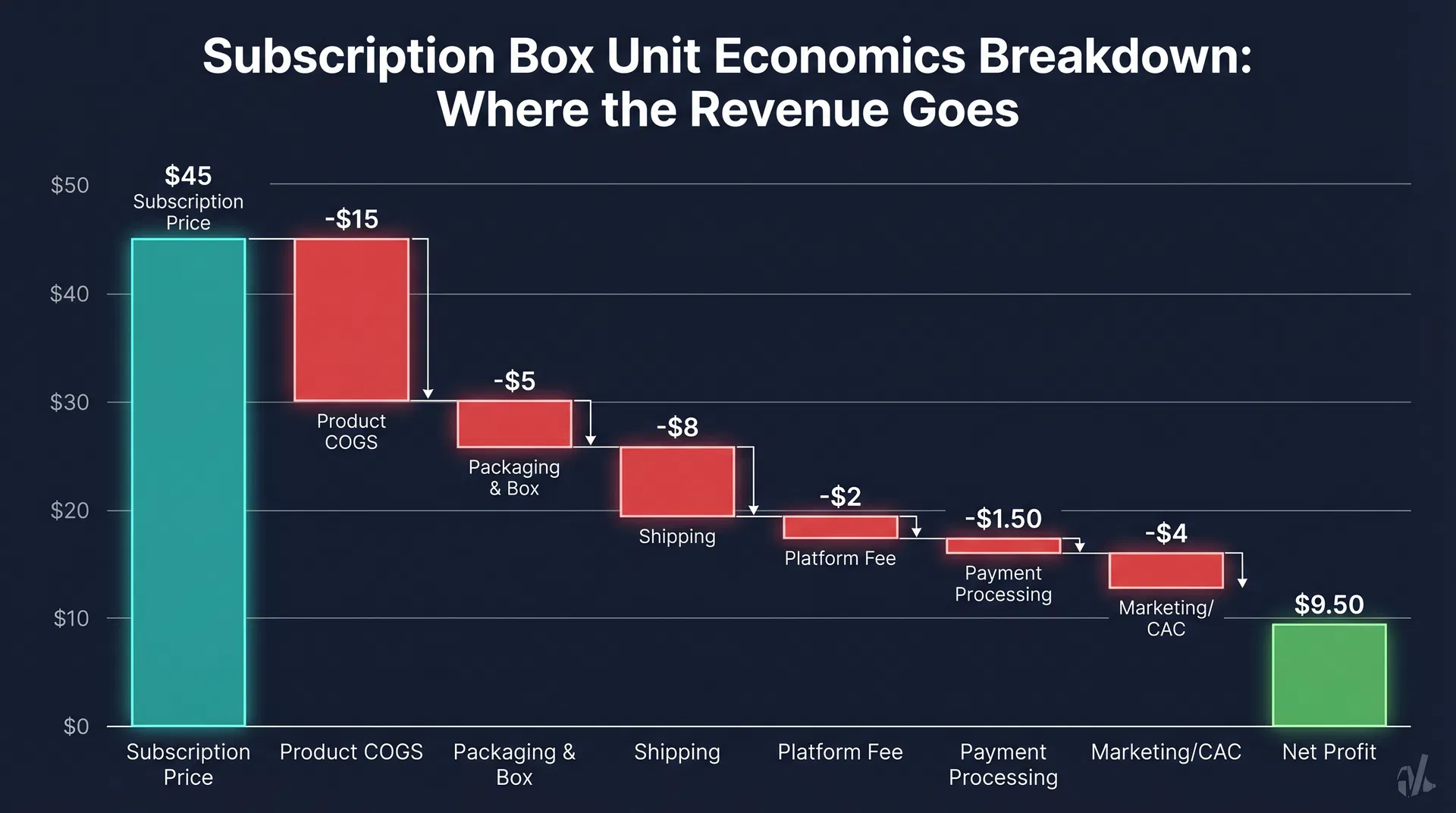
For a typical $45/month subscription box, the revenue breakdown looks roughly as follows. Product COGS (the cost of the items inside the box) typically runs 30-40% of the subscription price, or $13.50-18.00 for a $45 box. This is the most visible cost and the one most founders focus on — but it is rarely the largest margin driver.
Packaging costs are the second major cost category and are consistently underestimated. A custom branded box, tissue paper, inserts, stickers, and any additional packaging materials typically cost $3-6 per shipment for a mid-range subscription box. For premium boxes with elaborate unboxing experiences, packaging can reach $8-12 per shipment. This is a fixed cost per box that does not scale down with volume as quickly as product COGS, making it a significant margin factor at lower subscriber counts.
Shipping: The Cost That Breaks Most Subscription Box Businesses
Shipping is the cost that most subscription box founders get wrong, and it is often the primary reason subscription boxes fail to reach profitability. A fully packed subscription box typically weighs 1-3 lbs and has significant dimensional weight due to the box size. At retail shipping rates, this translates to $7-12 per shipment for standard ground delivery within the continental US. At volume-negotiated rates (available at 500+ shipments per month), costs can come down to $5-8 per shipment.
The math is unforgiving at low subscriber counts. At 100 subscribers paying $45/month, you are shipping 100 boxes per month. Even at $7 per box, that is $700 in monthly shipping costs on $4,500 in revenue — 15.6% of revenue going to shipping alone. At 1,000 subscribers with negotiated rates of $5.50 per box, shipping drops to 12.2% of revenue. The shipping cost as a percentage of revenue improves with scale, but it never becomes negligible.
Subscription boxes with higher price points have better shipping economics. A $75/month box with the same $7 shipping cost has a 9.3% shipping burden vs 15.6% for the $45 box. This is one of the primary reasons that successful subscription box businesses tend to price at $50+ rather than trying to compete at lower price points.
Platform and Payment Processing Fees
Most subscription box businesses use a dedicated subscription management platform such as Cratejoy, Subbly, or a Shopify subscription app. These platforms charge monthly fees plus transaction fees. Cratejoy charges a marketplace fee of 1.25% plus $0.10 per transaction for marketplace sales, and a platform fee for direct store sales. Subbly charges $0.59 per transaction plus a monthly platform fee. When combined with Stripe's payment processing fee of 2.9% plus $0.30 per transaction, total payment and platform costs typically run 4-6% of subscription revenue.
Failed payment recovery is a significant operational cost that is rarely modeled. Subscription businesses typically see 5-10% of monthly charges fail due to expired cards, insufficient funds, or bank declines. Recovering these failed payments requires automated retry logic, dunning email sequences, and sometimes manual outreach. The labor and technology cost of failed payment recovery adds another 0.5-1% to effective processing costs.
Customer Acquisition Cost and Churn: The Profitability Multipliers
The unit economics of a single box shipment are only part of the subscription box profit picture. The other critical variables are customer acquisition cost (CAC) and monthly churn rate, because these determine how many boxes you ship to each subscriber before they cancel — and therefore how much total profit you generate per customer acquired.
Subscription box CAC varies widely by niche and marketing channel, but industry benchmarks suggest $15-40 for boxes that rely primarily on social media and influencer marketing, and $40-80 for boxes using paid advertising as the primary acquisition channel. At a $9.50 net profit per box and a $35 CAC, you need to ship 3.7 boxes to a subscriber before you break even on the acquisition cost. At a 15% monthly churn rate (meaning 15% of subscribers cancel each month), the average subscriber stays for 6.7 months. That gives you 3 months of profitable contribution after recovering the CAC — a thin but workable margin if you can maintain those metrics.
Churn is the variable that most subscription box founders underestimate. A 10% monthly churn rate means you lose 10% of your subscriber base every month and must replace them just to maintain flat revenue. At 20% monthly churn, you are replacing one-fifth of your subscribers every month — a treadmill that requires constant marketing spend and makes it very difficult to grow. The most successful subscription boxes achieve monthly churn rates of 5-8%, which requires strong product curation, excellent packaging and unboxing experience, and consistent value delivery.
Gross Margin Benchmarks for Subscription Boxes
After accounting for product COGS, packaging, shipping, and platform fees, subscription boxes typically generate gross margins of 25-40% on the per-box economics. This is before marketing, customer service, operations overhead, and CAC amortization. Net margins after all costs typically range from 10-20% for well-run subscription boxes at scale (500+ subscribers), and are often negative or near-zero for boxes under 200 subscribers due to the fixed cost burden of operations.
The path to profitability in subscription boxes is almost always through scale. The fixed costs of operations, customer service, and content creation are largely the same whether you have 100 or 1,000 subscribers. The variable costs (COGS, packaging, shipping) improve modestly with volume through better supplier pricing and shipping rates. The result is a business model where margins improve significantly as subscriber count grows, which means the critical question is not "are we profitable today?" but "can we reach the scale where this business is profitable before we run out of cash?"
| Subscriber Count | Est. Net Margin | Key Constraint |
|---|---|---|
| Under 100 | Negative to 5% | Fixed ops overhead too high |
| 100–500 | 5–12% | Shipping rates not yet negotiated |
| 500–2,000 | 12–18% | CAC pressure from competition |
| 2,000–10,000 | 15–22% | Churn management critical |
| 10,000+ | 18–28% | Operational complexity |
Put these numbers to work
Run a real product analysis with landed cost, tariffs, and all fees calculated automatically.