

Walmart Marketplace Seller Fees in 2026: Complete Breakdown and Profit Calculator
Walmart Marketplace has grown significantly as a third-party selling platform, now hosting over 100,000 sellers and offering access to Walmart's 120 million monthly shoppers. For sellers evaluating whether to expand from Amazon or Shopify to Walmart, the fee structure is a critical input. Unlike Amazon, Walmart charges no monthly seller subscription fee and no per-item listing fees — but its referral fees and Walmart Fulfillment Services (WFS) costs can still meaningfully compress margins if not modeled correctly before launch.
This guide covers every Walmart Marketplace fee category in 2026, including referral fees by product category, WFS fulfillment fees, return processing costs, and how to calculate your true net profit margin on any product before you list it.
Walmart Marketplace Referral Fees by Category
Walmart's referral fee is the primary cost of selling on the platform. It is charged as a percentage of the total sale price including shipping, and it varies by product category. The majority of categories are charged at 15%, which is comparable to Amazon's standard referral fee for most categories. However, several high-volume categories carry lower rates that make Walmart meaningfully more attractive than Amazon for specific product types.
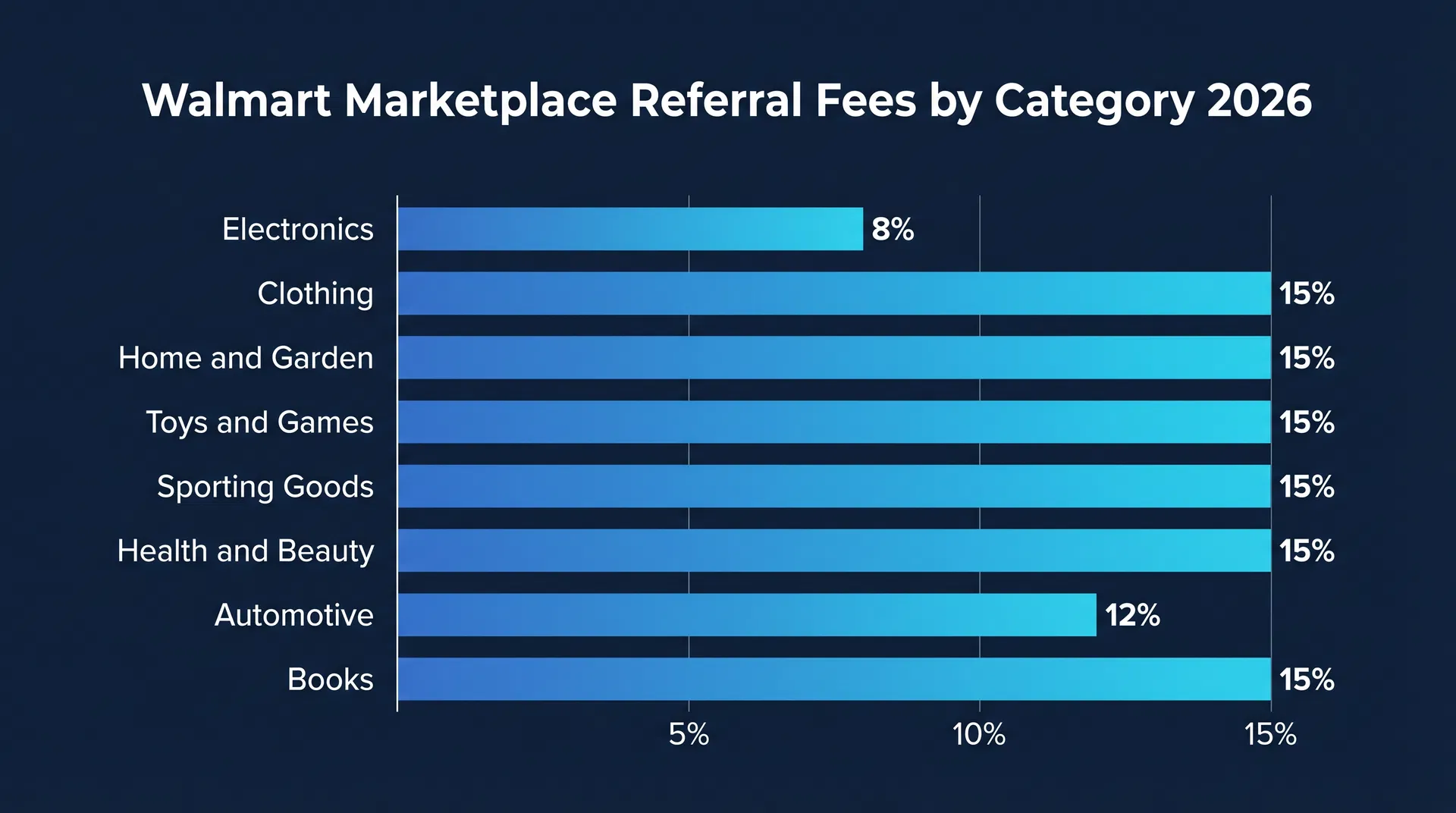
| Category | Referral Fee | Notes |
|---|---|---|
| Electronics | 8% | Lower than most Amazon categories |
| Clothing & Accessories | 15% | Standard rate |
| Home & Garden | 15% | Standard rate |
| Toys & Games | 15% | Standard rate |
| Health & Beauty | 15% | Standard rate |
| Sporting Goods | 15% | Standard rate |
| Automotive | 12% | Slightly below standard |
| Books, Music & Movies | 15% | Standard rate |
| Grocery & Gourmet | 8% | Lower rate for food |
| Baby | 15% | Standard rate |
Walmart Fulfillment Services (WFS) Fees
Walmart Fulfillment Services is Walmart's equivalent of Amazon FBA. WFS handles storage, picking, packing, and shipping for sellers who send inventory to Walmart's fulfillment centers. Using WFS gives products a "Fulfilled by Walmart" badge and makes them eligible for Walmart's two-day shipping promise, which significantly improves conversion rates and Buy Box eligibility.
WFS fulfillment fees are charged per unit and are based on shipping weight. For standard-size items, fees range from $3.45 for items under 1 lb to $7.95 for items between 10-20 lbs. Oversized items start at $9.50 and increase with weight. These rates are generally competitive with Amazon FBA for standard-size products, and often slightly lower for heavier items in the 5-20 lb range.
WFS storage fees are $0.75 per cubic foot per month from January through September, rising to $0.75 per cubic foot from October through December (Walmart does not apply the dramatic Q4 surcharge that Amazon does). Long-term storage fees apply to items stored more than 365 days at $1.50 per cubic foot per month. For sellers with seasonal inventory, Walmart's flat storage rate structure is a meaningful advantage over Amazon's Q4 tripling of storage costs.
Walmart vs Amazon: Fee Comparison for a Sample Product
To illustrate the real-world difference, consider a standard-size home goods product selling for $29.99 with a 1.5 lb shipping weight. On Amazon, the seller pays a 15% referral fee ($4.50) plus an FBA fulfillment fee of approximately $4.75 for a standard-size item in that weight range, totaling $9.25 in platform fees before advertising. On Walmart, the same product incurs a 15% referral fee ($4.50) plus a WFS fulfillment fee of approximately $4.25, totaling $8.75 in platform fees. The difference is modest but real, and it compounds across thousands of units.
For electronics products, the difference is more pronounced. A $49.99 electronics accessory on Amazon might incur a referral fee of $4.00-7.50 depending on the subcategory, while Walmart's 8% rate produces a $4.00 referral fee consistently. For high-volume electronics sellers, this difference can represent significant annual savings.
Walmart Marketplace Advertising Costs
Walmart Connect (Walmart's advertising platform) is less mature than Amazon Advertising but growing rapidly. Sponsored Products ads on Walmart typically have lower cost-per-click rates than equivalent Amazon campaigns, with average CPCs running $0.30-0.80 compared to Amazon's $0.80-2.50 for competitive categories. However, Walmart's search volume is also lower, so total advertising spend to achieve the same sales volume is often similar.
New sellers on Walmart Marketplace often find that organic ranking is easier to achieve than on Amazon, particularly in the first 90 days. Walmart's algorithm rewards new listings with temporary visibility boosts, and competition for top positions is lower in most categories. This means that advertising spend as a percentage of revenue is often lower on Walmart than Amazon during the launch phase, which improves early-stage margins.
Calculating Your True Net Margin on Walmart
To calculate your true net margin on Walmart Marketplace, start with your sale price and subtract: the referral fee (8-15% depending on category), WFS fulfillment fee (if using WFS), WFS storage cost per unit based on expected sell-through time, advertising cost per unit based on your target ACoS, return processing costs based on your expected return rate, and your landed cost per unit including product cost, freight, and import duties.
The resulting number is your net profit per unit. Divide by your sale price to get your net margin percentage. For most standard-size products in non-apparel categories, a well-run Walmart seller should target 12-20% net margin after all fees. Margins below 10% leave insufficient buffer for price competition, advertising adjustments, and inventory write-offs.
Put these numbers to work
Run a real product analysis with landed cost, tariffs, and all fees calculated automatically.
Related Articles