

Shopify Profit Margins by Niche: What Is Realistic in 2026?

Not all Shopify stores are created equal. A beauty brand selling $45 serums operates in a fundamentally different profit environment than a fashion store moving $28 t-shirts or an electronics accessories shop competing on $15 phone cases. Knowing the realistic net margin benchmarks for your specific niche is the starting point for building a business that actually generates cash, not just revenue.
Why Niche Determines Margin More Than Effort
Many new Shopify sellers assume that working harder or marketing better is the primary driver of profitability. In reality, the niche you choose sets the ceiling on your margins before you write a single product description. Niches with high perceived value, low return rates, and strong repeat purchase behavior produce structurally better margins than commodity niches where customers shop on price alone.
The four cost drivers that vary most by niche are: product cost as a percentage of sale price (COGS ratio), return rate, customer acquisition cost (CAC), and average order value (AOV). A niche with a low COGS ratio, low returns, low CAC, and high AOV will almost always outperform a niche with the opposite profile, regardless of how well the store is run.
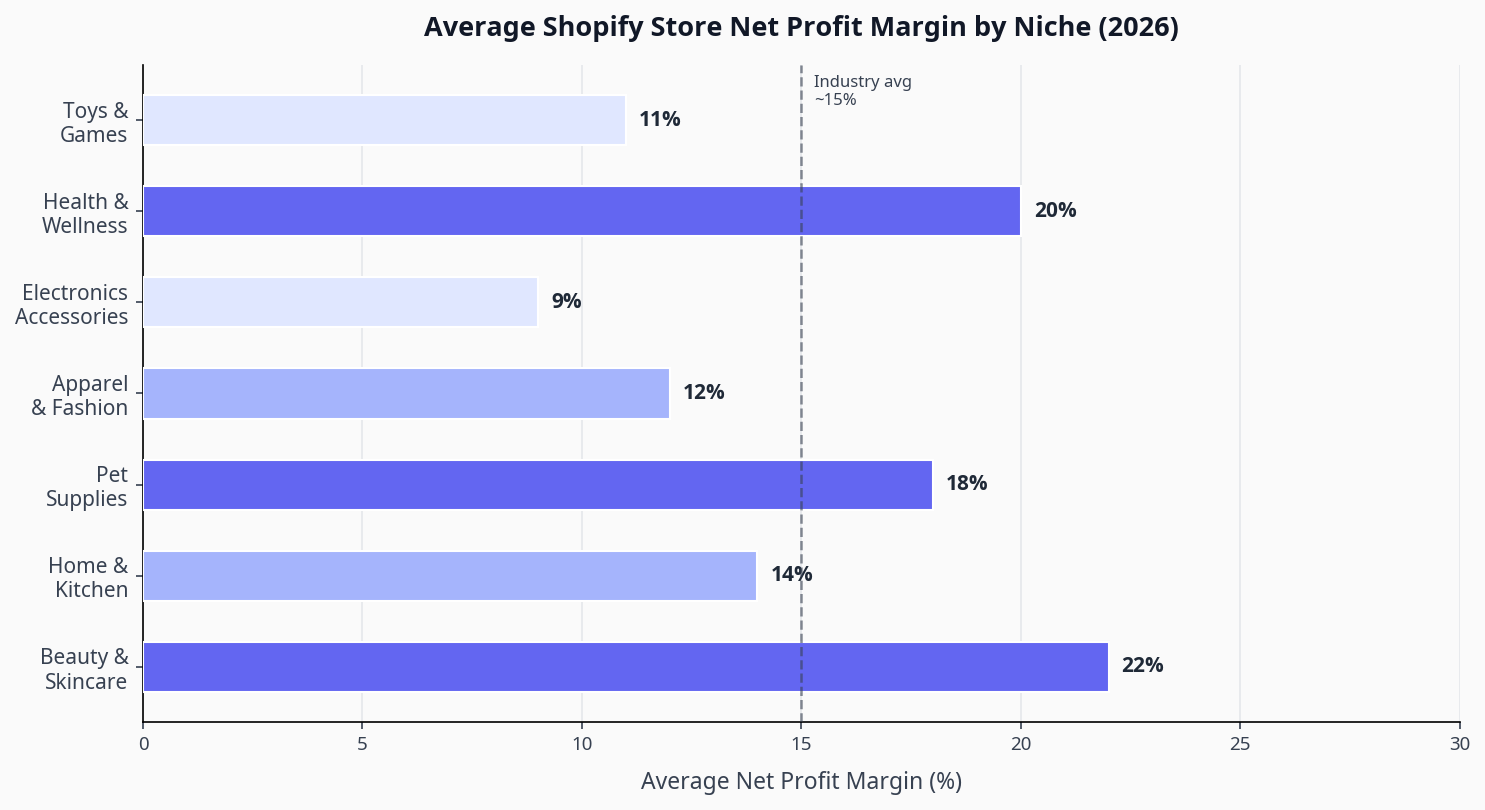
Beauty and Skincare: The High-Margin Leader
Beauty and skincare consistently produces the highest net margins among Shopify niches, typically ranging from 18% to 28% for established stores. The reasons are structural. Product cost ratios are favorable: a serum that costs $6 to manufacture can retail for $45-65 without raising consumer skepticism, because customers buy outcomes (clearer skin, reduced wrinkles) rather than ingredients. Repeat purchase rates are high because skincare is consumable. And brand loyalty, once established, reduces CAC over time as returning customers require no acquisition spend.
The risk in beauty is regulatory compliance and ingredient sourcing. Stores that cut corners on formulation or labeling face returns, chargebacks, and potential legal exposure that can wipe out margin gains quickly. The highest-margin beauty stores invest in quality control and build trust through transparency.
Health and Wellness: Strong Margins with Subscription Potential
Health and wellness products, including supplements, fitness equipment, and wellness devices, produce average net margins of 18-24% on Shopify. The supplement subcategory is particularly attractive because consumable products support subscription models, which dramatically reduce CAC on a per-order basis. A customer who subscribes to a monthly protein powder order may cost $35 to acquire but generate $420 in annual revenue with near-zero ongoing acquisition cost.
The challenge in health and wellness is regulatory scrutiny. The FTC and FDA have specific requirements around health claims, and stores that make unsubstantiated claims face enforcement actions. Staying within compliant messaging is not optional; it is a business survival requirement.
Pet Supplies: Emotional Purchasing Drives Premium Pricing
Pet supply stores on Shopify average 16-20% net margins. Pet owners are notoriously willing to spend premium prices on products they believe benefit their animals, which supports higher price points and better margins than the raw product quality might otherwise justify. Organic and natural pet food, premium grooming tools, and orthopedic pet beds all command significant price premiums over commodity alternatives.
Return rates in pet supplies are relatively low compared to apparel, which preserves margin. The primary margin risk is shipping cost: bulky items like pet beds and large food bags have high dimensional weight charges that can erode profitability if not priced correctly.
Apparel and Fashion: The Margin Trap
Apparel is the most difficult niche to generate strong margins in on Shopify, with average net margins of 10-14% for established stores and often negative margins for new stores still building their customer base. The structural problems are well-documented: return rates of 20-35% are standard (compared to 5-10% in most other niches), sizing complexity requires holding significant inventory across multiple SKUs, and fashion trends mean unsold inventory quickly becomes worthless.
Apparel stores that do generate strong margins typically succeed through one of three strategies: extremely high price points with strong brand positioning, made-to-order production that eliminates inventory risk, or a very narrow product focus that minimizes SKU complexity.
Electronics Accessories: Volume Play with Thin Margins
Electronics accessories (phone cases, cables, chargers, laptop stands) generate the lowest average net margins of major Shopify niches, typically 8-12%. Competition from Amazon, AliExpress, and direct-from-manufacturer sellers creates intense price pressure. CAC is high because customers shop on price and have low brand loyalty.
The stores that succeed in electronics accessories do so through volume and operational efficiency rather than margin expansion. Private labeling with unique design elements, bundling accessories into kits, and targeting professional or commercial buyers rather than consumers can all improve margins meaningfully.
Margin Benchmarks by Niche: Summary Table
| Niche | Avg Net Margin | Avg Return Rate | Key Margin Driver |
|---|---|---|---|
| Beauty & Skincare | 18-28% | 5-10% | Low COGS ratio, high repeat purchase |
| Health & Wellness | 18-24% | 6-12% | Subscription LTV |
| Pet Supplies | 16-20% | 8-12% | Emotional premium pricing |
| Home & Kitchen | 12-18% | 10-15% | High AOV / bundling |
| Toys & Games | 10-14% | 12-18% | Gift-giving seasonality |
| Apparel & Fashion | 10-14% | 20-35% | Brand loyalty required |
| Electronics Accessories | 8-12% | 10-16% | Volume and operational efficiency |
How to Improve Your Niche Margin
Regardless of niche, the most reliable margin improvement levers are: reducing return rate through better product photography and sizing guides, increasing AOV through bundles and upsells, building email and SMS lists to reduce paid CAC on repeat orders, and optimizing packaging and shipping costs. Even a 2-3 percentage point improvement in net margin, when applied to a $500,000 annual revenue store, is $10,000-$15,000 in additional annual profit.
Use ProfitBeacon's calculator to model your specific product economics before entering a niche. Enter your expected wholesale cost, sale price, platform fees, ad spend, and return rate to see whether your target niche can realistically support the margin you need to build a sustainable business.
Model Your Shopify Product Margins
Enter your product costs, Shopify fees, and ad spend to see your real net margin before you commit to a niche or product.
Open the Profit Calculator →Related Reading
Put these numbers to work
Run a real product analysis with landed cost, tariffs, and all fees calculated automatically.
Related Articles