

Product Bundling Strategy: How to Increase Profit Margins with Bundles

Product bundling is one of the most reliable profit improvement strategies available to ecommerce sellers, yet most stores use it inconsistently or not at all. A well-constructed bundle increases average order value, reduces the effective cost of customer acquisition, and can create a price anchor that makes individual products look like a bargain. Done correctly, bundling transforms a 10% net margin business into a 20% net margin business without changing a single product.
Why Bundling Improves Margins: The Math
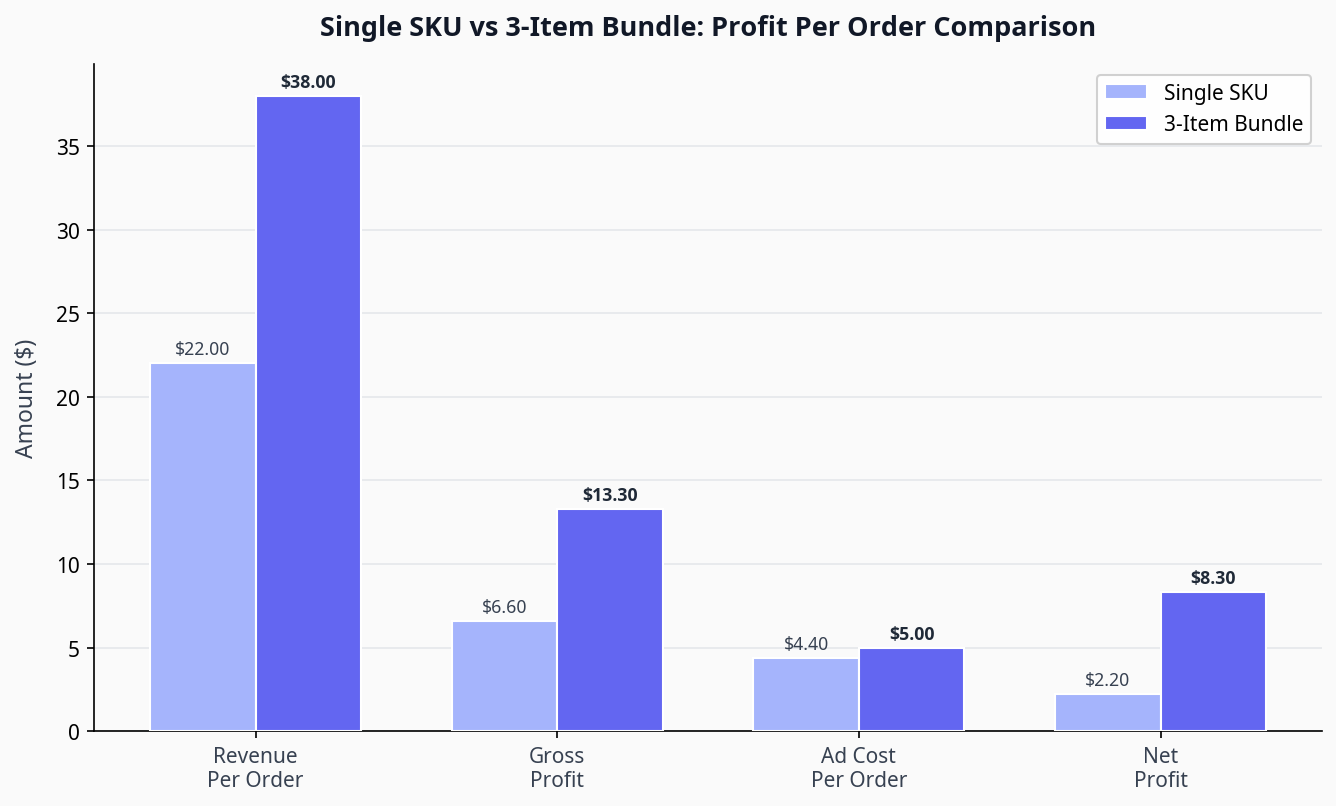
The profit improvement from bundling comes from two sources: higher revenue per transaction with a less-than-proportional increase in costs, and a fixed customer acquisition cost spread across more revenue. Consider a seller whose average order is one unit at $22, with a $6.60 gross profit (30% gross margin), a $4.40 ad cost per order (20% ACoS), and a $2.20 net profit per order — a 10% net margin.
Now the same seller introduces a 3-item bundle at $38. The bundle's combined product cost is $13.20. Gross profit on the bundle is $24.80 (65% gross margin). The ad cost to sell the bundle is $5.00, slightly higher than a single unit but not proportionally higher. Net profit on the bundle is $8.30, nearly four times the single-unit net profit on the same customer acquisition cost.
Types of Bundles and When to Use Each
Complementary bundles combine products that are naturally used together. A coffee brand might bundle whole beans, a hand grinder, and a pour-over dripper. These bundles work because they solve a complete problem rather than a partial one, and they attract buyers who are ready to commit to a new habit or activity. Complementary bundles typically command the highest price premiums because the perceived value of the complete solution exceeds the sum of the parts.
Quantity bundles offer multiple units of the same product at a per-unit discount. These work best for consumables where the customer will definitely use all units and benefits from stocking up. They reduce return rate and increase customer lifetime value by extending the repurchase cycle.
Curated gift bundles are pre-assembled collections positioned as gifts for specific occasions or recipients. A "new mom bundle," a "home office setup bundle," or a "weekend warrior bundle" all use curation to justify a premium price and reduce the customer's decision-making burden. Gift bundles are particularly effective in Q4 and around holidays.
Clearance bundles pair slow-moving inventory with fast-moving products to clear stock without discounting the hero product. A seller with excess inventory of a less popular color can bundle it with their best-seller at a modest discount, moving the slow inventory while protecting the best-seller's price integrity.
Pricing Your Bundle for Maximum Margin
The standard approach is to price the bundle at 10-20% below the sum of individual prices. This creates a clear, quantifiable savings that customers can calculate themselves, which increases conversion. A bundle priced at $38 when the individual items total $55 communicates a $17 saving — a compelling reason to buy the bundle over individual items.
The margin calculation that matters is: bundle net margin = (bundle price − total product cost − bundle-specific packaging cost − fulfillment cost − ad cost per bundle order) / bundle price. Run this calculation before launching any bundle. Many sellers create bundles intuitively without checking whether the bundle margin actually exceeds the single-unit margin. Sometimes it does not, particularly when bundle-specific packaging adds significant cost.
| Bundle Type | Typical Price Premium | Margin Impact | Best Channel |
|---|---|---|---|
| Complementary bundle | 15-30% vs individual sum | High (+5-15% net margin) | Own store, Amazon |
| Quantity bundle (3-pack) | 10-20% discount on per-unit | Medium (+3-8% net margin) | Amazon, Shopify |
| Curated gift bundle | 20-40% vs individual sum | High (+8-18% net margin) | Own store, Etsy |
| Clearance bundle | 5-15% discount on hero item | Low-Medium (clears dead stock) | Own store |
Bundling on Amazon vs Your Own Store
On Amazon, virtual bundles allow you to create bundle listings without physically kitting the products, which reduces operational complexity. Physical bundles require a separate ASIN and must be listed as a single unit, which means you need to physically assemble and label them before sending to FBA.
On your own store, bundling is operationally simpler because you control fulfillment. You can offer bundles as product variants, use bundle apps like Bundler or Bold Bundles to create dynamic bundle pricing, or simply create a new product listing that includes multiple items. The flexibility of your own store makes it easier to test bundle configurations and pricing before committing to physical kitting.
Bundle Performance Metrics to Track
Bundle attach rate is the percentage of customers who choose the bundle over individual items when both are available. A bundle attach rate above 15-20% is generally considered successful. Bundle margin premium is the difference between your bundle net margin and your single-unit net margin; if the bundle margin is not higher, the bundle is not working as intended.
Average order value (AOV) is the most visible metric and the one most sellers track. But AOV improvement without margin improvement is not a success — it is just more revenue with the same or worse profitability. Always track bundle margin alongside AOV to ensure the bundle is actually improving your business economics.
Building Bundles Into Your Profit Model
When you model a new product, consider running two scenarios: one for the single-unit sale and one for your planned bundle. If your bundle scenario shows a significantly higher net margin, that is a strong signal to prioritize bundle promotion in your marketing. The calculator's inputs for sale price, product cost, and ad cost per sale let you model both scenarios side by side.
Model Your Bundle Margins
Run two scenarios in ProfitBeacon to compare single-unit vs bundle profitability before you invest in kitting or bundle listings.
Open the Profit Calculator →Related Reading
Put these numbers to work
Run a real product analysis with landed cost, tariffs, and all fees calculated automatically.
Related Articles