

eBay Selling Fees Explained: What They Actually Cost Your Profit Margin in 2026
eBay remains one of the largest resale and ecommerce marketplaces in the world, with over 132 million active buyers as of 2025. For sellers, the platform offers genuine reach and a buyer base that is often willing to pay more for rare, used, or niche products than they would on Amazon. But eBay's fee structure is layered in a way that surprises many new sellers. Understanding exactly what you pay, and when you pay it, is the foundation of calculating whether any given product is worth selling on the platform at all.
The Core eBay Fee Structure in 2026
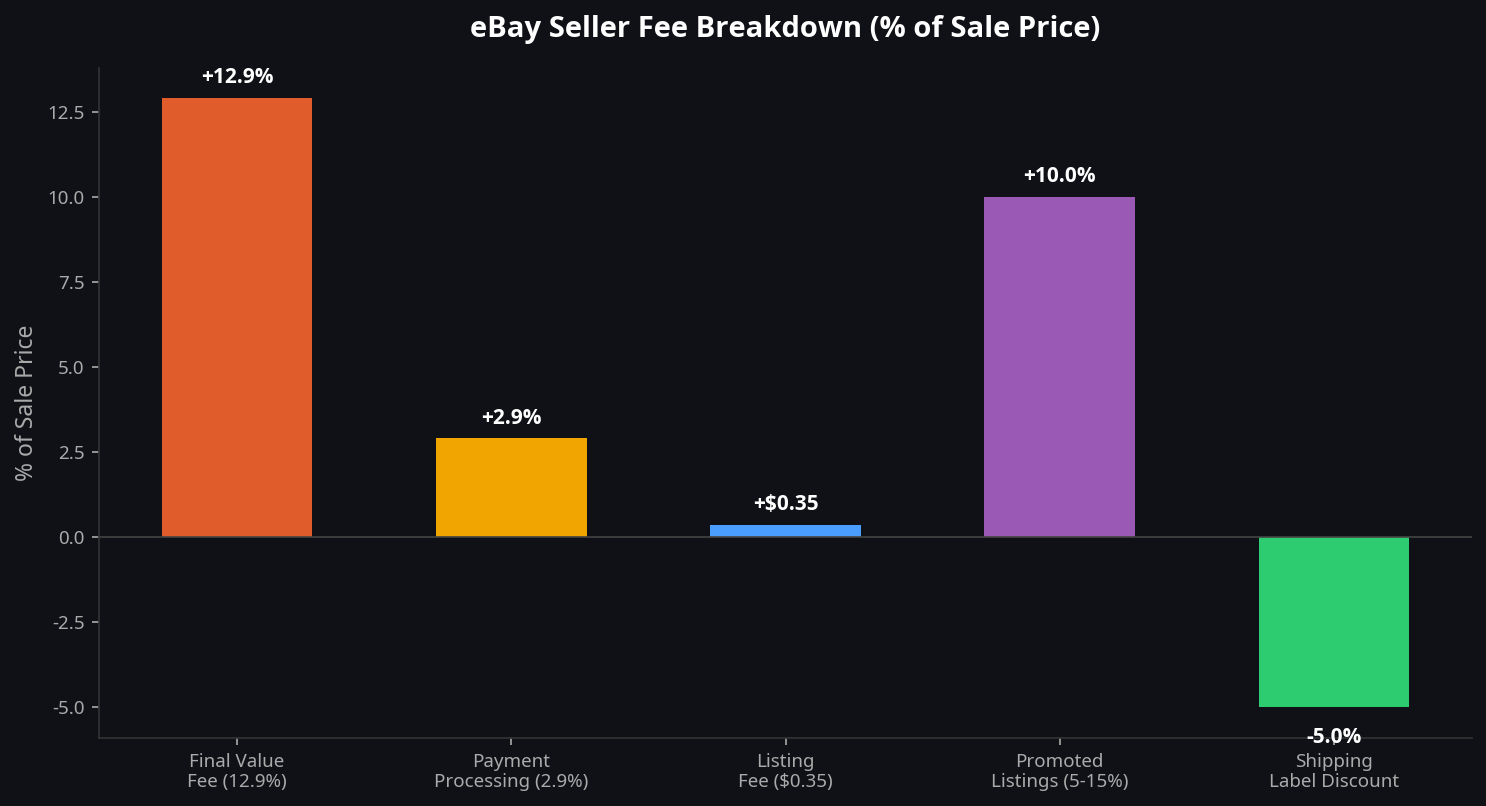
eBay charges sellers through four primary mechanisms: insertion fees, final value fees, payment processing fees, and optional promoted listing fees. Each one takes a slice of your revenue at a different stage of the transaction. Together, they typically consume between 13% and 18% of your sale price before you account for shipping, COGS, or returns.
Insertion fees are charged when you create a listing. Most sellers receive 250 free listings per month, after which eBay charges $0.35 per listing. For high-volume sellers listing hundreds of SKUs, this adds up quickly. A seller listing 500 unique items per month pays $87.50 in insertion fees alone before making a single sale.
Final value fees are the largest cost. eBay charges a percentage of the total sale amount, including shipping, when an item sells. The rate varies by category but is typically 12.9% for most product categories, with a $0.30 per-order charge added on top. Some categories like motors and real estate have different structures, but for the typical ecommerce seller in electronics, clothing, home goods, or collectibles, 12.9% is the baseline.
Payment Processing: The Hidden 2.9%
eBay Managed Payments, which became mandatory for all sellers in 2021, handles all payment processing through eBay directly. The fee is 2.9% of the total transaction value plus $0.30 per order for most sellers. For sellers processing over $10,000 per month in sales, the rate drops slightly. This fee is separate from the final value fee and is often overlooked when sellers calculate their margins.
Combined, the final value fee and payment processing fee alone consume approximately 15.8% of a typical $50 sale. On a $25 item, the per-order fixed charges ($0.30 + $0.30) represent an additional 2.4%, pushing the effective fee rate to over 18% for lower-priced items. This is why eBay is generally better suited to higher-ticket products where the fixed per-order charges become a smaller percentage of revenue.
Promoted Listings: Necessary but Expensive
eBay's Promoted Listings Standard program lets sellers pay an additional percentage of the sale price (called an ad rate) to appear higher in search results. The ad rate is set by the seller and currently ranges from around 2% to 15% depending on category competitiveness. Critically, you only pay the promoted listings fee when a buyer clicks your promoted ad and then purchases within 30 days.
In practice, most competitive categories require promoted listings to maintain visibility. Sellers who skip promoted listings often see a significant drop in impressions and sales. A typical ad rate of 5-8% on top of the existing 15.8% in base fees means effective total fees of 20-24% for promoted sellers. At that level, a product needs a gross margin of at least 30-35% before fees to generate any meaningful net profit.
Calculating Your Real eBay Profit Margin
The formula for a true eBay net margin calculation requires accounting for every cost layer. Starting from your sale price, subtract: COGS (product cost + inbound shipping), eBay final value fee (12.9% + $0.30), payment processing (2.9% + $0.30), promoted listings fee (if applicable), outbound shipping cost (if not charged to buyer), and returns/refunds reserve (typically 2-4% of revenue for most categories).
As a practical example: a $75 product with a $20 landed cost, $8 shipping to buyer, and a 7% promoted listings rate generates the following: $75 revenue minus $20 COGS, minus $9.68 final value fee, minus $2.48 payment processing, minus $5.25 promoted listings, minus $8 shipping, minus $1.50 returns reserve. Net profit: approximately $28.09, or a 37.5% net margin. That is a healthy outcome, but only because the product has a strong gross margin to begin with.
eBay Store Subscriptions: When Do They Pay Off?
eBay offers store subscription tiers (Starter at $7.95/mo, Basic at $27.95/mo, Premium at $74.95/mo, Anchor at $349.95/mo, Enterprise at $2,999.95/mo) that provide discounted final value fees and more free listings. The Basic store, for example, reduces final value fees to 12.35% in most categories and provides 1,000 free listings per month.
The math on store subscriptions is straightforward: divide the monthly subscription cost by the fee savings per sale to find your break-even volume. A Basic store saves approximately 0.55% per sale. On a $50 average sale price, that is $0.275 per sale. To break even on the $27.95 monthly fee, you need to sell approximately 102 items per month. Sellers doing more than that volume benefit from the subscription; those doing less do not.
eBay vs. Amazon: Which Platform Has Lower Fees?
Amazon's referral fee is typically 15% for most categories, plus FBA fees of $3.22 to $6.00+ per unit depending on size and weight. For a standard-size product, Amazon's total fees often run 25-35% of sale price when FBA is included. eBay's fees, even with promoted listings, typically run 18-22%. On paper, eBay is cheaper. But Amazon's higher traffic volume and Prime buyer trust often allow sellers to charge higher prices, which can offset the fee difference.
The right answer depends on your product. High-margin, niche, or collectible items often perform better on eBay where buyers are willing to pay a premium and competition is lower. Commodity products with thin margins and high search volume typically do better on Amazon where the fulfillment infrastructure and Prime badge justify higher prices.
Key Takeaways for eBay Sellers
Before listing any product on eBay, calculate your floor price by working backwards from your required net margin. If you need a 20% net margin and your total eBay fees (including promoted listings) run 22%, your product needs a gross margin of at least 42% before fees to hit your target. Products with gross margins below 35% are very difficult to make profitable on eBay once all fees, shipping, and returns are factored in.
Use a profit calculator to model each product before you source it. The difference between a 12% and 18% total fee rate on a $40 product is $2.40 per sale, which sounds small but represents the difference between a profitable business and one that is slowly losing money at scale.
Related Reading
References
[1] eBay Seller Center — Selling fees: https://www.ebay.com/help/selling/fees-credits-invoices/selling-fees
[2] eBay Managed Payments — Payment processing fees: https://www.ebay.com/help/selling/getting-paid/managed-payments-sellers/payment-processing-fees
[3] eBay Promoted Listings — Ad rates: https://www.ebay.com/help/selling/promoted-listings/promoted-listings-standard
Put these numbers to work
Run a real product analysis with landed cost, tariffs, and all fees calculated automatically.
Related Articles